






Which Cream for Stretch Marks Is Best After Delivery?

Medically Reviewed By:
Dr. Mousumi Dash, BAMS
Written by Our Editorial Team
Dr. Mousumi Dash, BAMS
Written by Our Editorial Team
Medically Reviewed By:About the Reviewer
You've just had a baby, you have about four minutes to yourself, and you'd like someone to simply tell you what to buy. So here it is. The best stretch mark cream after delivery is one that's safe to use while breastfeeding, built on a genuinely rich base with ingredients like centella, rosehip oil and vitamin E — and started while your marks are still red or purple. That last part matters more than the brand on the tube. Red marks respond far better to treatment than silvery-white ones, and right now yours are almost certainly still red. That's a window, and it does close. This guide covers what to avoid while you're nursing, how to tell which stage your marks are at, and what a realistic result actually looks like.
Key Takeaways
-
Safe-while-nursing comes first. If it isn't, nothing else about the cream matters.
-
Skip retinoids completely while breastfeeding — they work, but not now.
-
Red and purple marks respond much better than old white ones. You're in the good window.
-
Start now rather than at the six-month mark. Waiting costs you results.
-
Look for a rich emollient base with centella, rosehip oil and vitamin E.
-
Expect marks to flatten and fade, not disappear. Complete clearance is genuinely rare.
-
Applying it twice a day for three months matters more than which brand you choose.
Why Starting Now Matters More Than Which Cream You Pick
Because red marks and white marks are two different problems — and right now you have the easier one.
Fresh stretch marks are red, pink or purple because there's still active blood flow running through them and the skin underneath is actively remodelling itself. Doctors call these striae rubra. Over months to years they settle into striae alba: silvery-white, slightly sunken, a little shiny. By then the blood vessels have receded and what's left is thin, scarred tissue — much harder for anything applied on top to influence.
Dermatology reviews are unusually direct about what this means. Early marks respond better to every form of treatment that's been studied, and the reviewers conclude it is vital to start treatment as early as possible.
Here's the frustrating irony, and it's worth naming. The months right after delivery feel like the worst possible time to take on a skincare routine. You're not sleeping, you're feeding every two hours, and your own body is somewhere near the bottom of the list. And this is, genuinely, the best window you will ever get for this one specific thing. Not because you should feel pressured — but because knowing it makes those two minutes a day feel worth protecting.
How to Tell Which Stage Your Marks Are At
Look at the colour, not the size. Colour tells you what stage the mark is in, and that's what predicts how much it will improve.
|
What you see |
Stage |
What to expect |
|
Red, pink or purple, sometimes slightly raised |
Early (striae rubra) |
Best response. Treat now |
|
Fading to light brown or greyish |
Transitioning |
Still responsive. Don't wait |
|
Silvery-white, slightly sunken, shiny |
Mature (striae alba) |
Slower, partial improvement |
If you're reading this in the first few months after delivery, you're almost certainly in one of the first two rows — which is the good news. If you're looking at white marks from a pregnancy a few years ago, that's a different and harder conversation, and it's worth understanding the difference between red and white stretch marks before you spend anything. Treating old stretch marks takes a different approach and a lot more patience.
Which Ingredients to Avoid While Breastfeeding
One ingredient rules a cream out entirely — and it's the one most "fast results" products are built around.
-
Retinoids (retinol, tretinoin, retinyl palmitate). These genuinely work on stretch marks. They're also not used during pregnancy or breastfeeding. Read the label properly, because anything positioned as anti-ageing or "repair" very often contains one, sometimes listed under a name you wouldn't recognise.
-
Hydroquinone. Not really a stretch mark ingredient, but it turns up in combination creams marketed for "marks and scars," which is exactly what you'll be searching for.
-
High-strength salicylic acid. Fine in a face wash. Different matter when you're spreading it across your whole stomach twice a day while nursing.
-
Heavy essential-oil blends. Keep these away from the chest area regardless of how natural the packaging looks.
-
"Natural" used as a safety claim. Worth being blunt here: natural doesn't mean safe while breastfeeding. Safety depends on the specific ingredient, not on how the brand positions itself. Plenty of essential oils are entirely natural and still not advisable right now.
And one practical thing nobody tells you: whatever you end up using, keep it off the breast and nipple area, and wash your hands before you feed. It's a small habit that removes the worry entirely. If you want the full breakdown, stretch mark cream safe ingredients goes through what's cleared and what isn't.
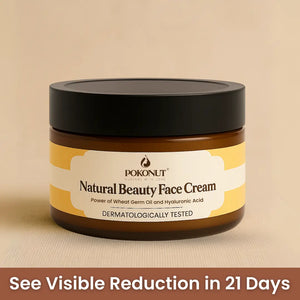
The simplest way to shortcut all of this is to check whether a brand states its position openly. Pokonut's stretch mark cream, for instance, is formulated without retinoids, parabens or artificial fragrance, and its own guidance says to use it on healthy, fully healed skin after delivery — and to keep it off an unhealed C-section incision. That kind of specific instruction is a better signal than a "mom-safe" badge, because it tells you the brand has actually thought about the situation you're in. Whatever you choose, run it past your doctor if you're nursing.
What the Research Says About Stretch Mark Creams After Delivery
The evidence here is more modest than the marketing, and knowing that genuinely helps you choose better — because it tells you where to put your effort.
|
What was studied |
What the evidence shows |
|
Do creams prevent stretch marks in pregnancy? |
A Cochrane review of topical preparations found insufficient evidence that any cream reliably prevents stretch marks. If yours appeared despite using something faithfully, that was never your failure. |
|
Do early marks respond better than old ones? |
Dermatology reviews state directly that early striae rubra respond better to treatment than mature striae alba, and conclude it is "vital to start the treatment as early as possible." |
|
Does any topical formula actually help early marks? |
A randomised, double-blind, placebo-controlled trial found an emollient containing rosehip oil, Centella asiatica triterpenes and vitamin E reduced the severity of early stretch marks. |
|
Can a cream remove them completely? |
The same reviews are blunt: full clearance of stretch marks is very rare with any treatment, topical or clinical. Real improvement means flatter, paler and less noticeable. |
|
How common is this? |
Stretch marks in pregnancy are reported in roughly 50–90% of pregnancies across studies. Which is to say: most women. You are very much the norm, not the exception. |
The detail that should change what you buy
Buried in the commentary on that successful trial is something unusually useful. The reviewers noted that the moisturiser base itself may be doing much of the work, and openly questioned how much the individual active ingredients were adding on top.
Read that again, because it cuts against almost everything you'll be sold. It means a thick, genuinely rich cream that you will actually apply twice a day beats a thin, expensive serum with an impressive ingredient list that you abandon somewhere in week three. The base is not the boring part of the formula. It may well be the working part.
Which is good news when you're three weeks postpartum, because it means the thing that decides your result is the thing most within your control.
References
-
Management of stretch marks (with a focus on striae rubrae). Journal of Cutaneous and Aesthetic Surgery. Read on JCAS
-
Young GL, Jewell D. Creams for preventing stretch marks in pregnancy. Cochrane Database of Systematic Reviews. Read on Cochrane Library
Further reading includes Korgavkar K, Wang F. Stretch marks during pregnancy: a review of topical prevention. British Journal of Dermatology, 2015.
What Makes a Cream Right for After Delivery
A rich base, evidence-backed actives, nursing-safe, and a texture you'll genuinely keep using. In that order — because the fourth one is what most routines actually fail on.
What to look for:
-
A genuinely rich base. Butters and oils like shea and cocoa, not a watery lotion. Given what the research suggests about the emollient doing much of the work, this is the part to be fussy about.
-
Centella asiatica. Of the commonly used actives, this one has the most supportive evidence behind it.
-
Rosehip oil and vitamin E. Both appeared in the formula that reduced severity in a controlled trial, which puts them ahead of most ingredients on a crowded label.
-
Hyaluronic acid for hydration — though it's worth being honest that hyaluronic acid has weaker evidence here than it does elsewhere in skincare.
-
Peptides, if they're in there, are a reasonable addition — peptides support collagen repair, though they're not the deciding factor.
-
Nursing-safe and light on fragrance, since you're applying this daily around a newborn.
-
A texture that actually absorbs. A cream you can put on one-handed at 2am is a cream that works, because consistency is the variable that decides your outcome. Something that sits greasy on your skin for twenty minutes will be abandoned, however good the formula.
If you'd like to see how specific products compare on these criteria, the full roundup of the best stretch mark cream in India goes through them side by side.
How to Use It So It Actually Works
Twice a day, massaged in properly, for at least 8 to 12 weeks. The protocol is simple — the hard part is building it into a life that currently has no routine at all.
-
Get your doctor's clearance first if you had a C-section, and keep cream well away from the incision until it's completely healed. The scar and the stretch marks are separate issues on separate timelines.
-
Apply twice daily — and attach it to something you already do, like straight after a shower and last thing before bed. A new habit that depends on remembering won't survive the newborn months. One that piggybacks on an existing habit will.
-
Massage for 30 to 60 seconds rather than just smoothing it on. The mechanical action appears to matter, and it also means the cream actually gets in.
-
Cover the whole area, not only the marks you can already see. More are often forming at the edges of the ones you've noticed.
-
Keep it off the chest and nipples, and wash your hands before feeding.
-
Give it 8 to 12 weeks before you decide whether it's working, and take a photo in the same light every fortnight. Gradual change is invisible day to day and perfectly obvious in a side-by-side.
What Results Look Like, Honestly
Expect your marks to flatten, pale and blur into your skin — not to disappear. And expect that to take two to three months of twice-daily use before it's clearly visible.
That's a less exciting promise than most products make, and it's the accurate one. The research is clear that complete clearance is rare with any treatment, including clinical procedures. What does happen reliably, with consistent use on early marks, is that they stop being raised, stop being red, and stop being the first thing you notice when you look in the mirror.
So what does a formula built around that actually look like? The Pokonut Stretch Mark Cream is a reasonable example of the shape to look for: a thick shea butter base doing the emollient work the research points to, rosehip oil — one of the ingredients from that controlled trial — plus mulethi and hyaluronic acid, with no retinoids anywhere in it. Used morning and night on fresh, still-red marks, that combination is working in the stage where treatment genuinely moves the needle.
Worth noting what its own page says too: "No cream can guarantee complete stretch mark removal." That's the right expectation to start with. You may notice skin feeling softer and marks looking less angry within the first month, but give it the full two to three months before you judge how much they've actually faded.
The rest of your postpartum skin tends to need some attention around the same time — pigmentation, dryness, hair shedding — and postpartum skin care covers how to fit that around feeding without a complicated routine.
When a Cream Isn't Enough
If your marks have already turned white, or you've given a cream a fair three months with nothing to show, topical treatment has reached its ceiling. That's worth knowing rather than buying a fourth tube.
What dermatologists use at that point: microneedling, fractional lasers and, for red marks specifically, vascular lasers. One honest caveat from the same literature — improvement on mature white marks is limited even with these, and the reviews describe results on striae alba as poor. That's genuinely useful to know before you commit to a clinic package, because the pitch you'll hear will be considerably more optimistic than the published data.
The Bottom Line
The best stretch mark cream after delivery isn't a brand — it's a set of conditions. Safe while nursing, genuinely rich, carrying centella, rosehip oil and vitamin E, and started while your marks are still red. The evidence says prevention creams don't reliably work, that early marks respond far better than old ones, and that complete clearance is very rare. So the realistic goal is flatter and fainter, the realistic timeline is two to three months, and the thing that decides your result is whether you keep applying it — not which tube you picked off the shelf.
About Doctor :