









Best Tan Removal Soap by Dermatologists in India (2026)
- 1 What Do Dermatologists Actually Say About Tan?
- 2 Best Tan Removal Soap by Dermatologist Standards: 2026 Comparison
- 3 Which Ingredients Do Dermatologists Recommend for Tan Removal?
- 4 Which Tan Removal Soap Suits Your Skin Type?
- 5 Why Do Some People See Better Results Than Others?
- 6 How to Use a Tan Removal Soap Correctly
- 7 How Long Does It Take to Fade a Tan?
- 8 Soap or Clinic — When Should You See a Dermatologist?
- 9 Conclusion

Medically Reviewed By:
Dr. Mousumi Dash, BAMS
Written by Our Editorial Team
Dr. Mousumi Dash, BAMS
Written by Our Editorial Team
Medically Reviewed By:About the Reviewer
In India, tan is hard to avoid. Daily commutes, outdoor work, and weekend trips leave the face, neck, arms, and shoulders looking darker and duller than the rest of the body. The good news is that tan fades. With a gentle soap, the right ingredients, and daily sun protection, most people see clearer, more even skin within a few weeks. This guide explains what actually works, and how to pick the soap that suits your skin.
Key Takeaways
-
Tan is your skin making extra melanin to protect itself from UV rays. It is not dirt.
-
Good de-tan soaps work by gently exfoliating dead cells and slowing melanin — not by bleaching.
-
Surface tan usually softens in 2–4 weeks; deeper tan takes 6–8 weeks or more.
-
Sunscreen is essential. Without it, tan keeps coming back.
-
Gentle, hydrating formulas suit daily use better than harsh actives.
What Do Dermatologists Actually Say About Tan?
Two common myths are worth clearing up first.
Myth 1: Tan is dirt you can scrub away. It is not. When UV rays hit your skin, cells called melanocytes produce more melanin, the pigment that gives skin its colour. This is your body's natural defence against sun damage. Because the pigment sits inside your skin cells, no amount of harsh scrubbing removes it. Over-scrubbing only damages the skin barrier and can leave skin red, dry, and more sensitive.
Myth 2: Tan removal means bleaching. It does not. Safe de-tanning works in three simple ways:
-
Gentle exfoliation clears the top layer of tanned, dead skin cells so fresh, lighter skin shows through.
-
Brightening actives slow down melanin production so new pigment forms more slowly.
-
Barrier care keeps skin hydrated, because dry, damaged skin looks duller and heals slower.
Your skin naturally renews itself over roughly four weeks. A good soap supports that cycle. It does not override it — which is why patience matters more than strength.

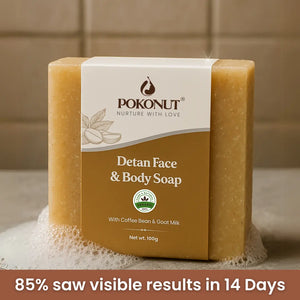
Pokonut Tan Removal Soap
Sun exposure doesn't have to mean long-term damage. Pokonut Tan Removal Soap is crafted to gently exfoliate, deeply n...
Shop Now →Best Tan Removal Soap by Dermatologist Standards: 2026 Comparison
Here are five trusted options, compared by ingredients and skin fit.
|
Soap |
Key Ingredients |
Why It Works |
Best For |
|
Goat Milk, Coffee Grounds, Shea Butter, Licorice |
Gentle lactic-acid exfoliation plus natural brightening, without harsh actives |
Face & body, sensitive skin, daily use |
|
|
Dermatouch Kojic Acid + Glutathione |
1% Kojic Acid, Glutathione |
Strong melanin-blocking action |
Deep, stubborn tan |
|
Ethiglo Skin Whitening Soap |
Arbutin, Salicylic Acid, Licorice |
Gentle brightening with mild exfoliation |
Mild to moderate tan |
|
Beardo De-Tan Coffee Detox Bar |
Coffee Extract, Natural Exfoliants |
Exfoliates tanned dead cells |
Body tan, men's skincare |
|
Deyga Charcoal Bath Bar |
Activated Charcoal, Natural Oils |
Deep cleansing, lifts surface dullness |
Oily, acne-prone skin |
Which Ingredients Do Dermatologists Recommend for Tan Removal?
The ingredient list matters more than the packaging. These are the actives widely accepted for fading tan.
|
Ingredient |
How It Works |
Best For |
|
Goat Milk (Lactic Acid) |
A mild AHA that gently loosens dead, tanned skin cells while hydrating |
Sensitive and dry skin, daily use |
|
Natural exfoliant that buffs away dull surface cells |
Body tan, rough or dull skin |
|
|
Contains glabridin, which helps slow melanin and calm skin |
Mild tan, sensitive or reactive skin |
|
|
Shea Butter |
Rich in vitamins A and E; repairs and nourishes the skin barrier |
Dry, sun-stressed skin |
|
Blocks tyrosinase, the enzyme that makes melanin |
Deep, stubborn tan |
|
|
Slows melanin transfer and strengthens the barrier |
Dullness, mild pigmentation |
|
|
Antioxidant that brightens and reduces melanin |
Uneven tone, sun damage |
|
|
Gentle melanin blocker with low irritation risk |
Sensitive skin, uneven tone |
|
|
Glutathione |
Antioxidant that supports brighter-looking skin |
Dull, tanned skin |
|
AHAs (Glycolic, Lactic) |
Exfoliate the top layer to reveal fresher skin |
Rough, tanned, uneven skin |
|
Charcoal |
Deep-cleanses pores and lifts surface buildup |
Oily, acne-prone skin |
One honest note on strong actives. Kojic acid and glutathione do work, and dermatologists use them often. But in soap form, they can dry or irritate sensitive skin with daily use, especially on the face. If your skin reacts easily, gentler actives like lactic acid, licorice, and alpha arbutin give steadier results with less risk.
Which Tan Removal Soap Suits Your Skin Type?
|
Skin Type |
Look For |
Avoid |
|
Oily / acne-prone |
Charcoal soap, coffee, lightweight cleansing |
Heavy, greasy bars |
|
Dry / flaky |
Goat milk, shea butter, glycerin, aloe |
Strong acids used alone |
|
Sensitive |
Licorice, goat milk, fragrance-free, gentle formulas |
High-strength kojic acid, harsh scrubs |
|
Dull / uneven |
Vitamin C, licorice, mild AHAs |
Bleaching claims |
|
Combination |
Balanced cleansing with hydration |
Over-exfoliating bars |
Why Do Some People See Better Results Than Others?
Two people can use the same soap and get different results. This is normal, and the reasons are practical:
-
Sun exposure. Someone outdoors for hours daily keeps forming new tan while fading the old one.
-
Sunscreen habits. This is the single biggest factor. Without SPF, tan returns as fast as it fades.
-
Depth of tan. Fresh tan sits near the surface and clears quickly. Months-old tan sits deeper and takes longer.
-
Skin type. Deeper skin tones produce more melanin, so fading is gradual — but the same ingredients still work.
-
Consistency. Skin renews roughly every four weeks. Using a soap twice a week will not match daily use.
-
Rest of the routine. Moisturiser, sunscreen, and simple at-home de-tan care do as much work as the soap.
How to Use a Tan Removal Soap Correctly
Most people use de-tan soap wrongly by washing it straight off. Actives need contact time to work.
-
Wet your skin with lukewarm water. Hot water dries skin out.
-
Lather the soap in your hands or on a loofah.
-
Apply to tanned areas and leave the lather on for 30–60 seconds. This is the step most people skip.
-
Rinse well with lukewarm water.
-
Pat dry and apply a moisturiser while skin is still slightly damp.
-
Every morning, finish with broad-spectrum sunscreen, SPF 50.
Sunscreen is not optional. Health and dermatology bodies worldwide agree that UV exposure is what causes tan in the first place. Without daily protection, you are fading tan with one hand and creating it with the other.
How Long Does It Take to Fade a Tan?
Tan does not clear overnight, because your skin renews itself on its own schedule.
-
Fresh, surface tan: Often looks visibly lighter in 2–4 weeks with daily use.
-
Older, deeper tan: Usually needs 6–8 weeks or longer, since the pigment sits deeper. Pairing it with the right daily habits speeds this up.
-
Pigmentation and melasma: These are different from simple tan and can take months, often needing a dermatologist's help.
No soap can strip tan away in one wash. Any product promising that is overselling.
Soap or Clinic — When Should You See a Dermatologist?
A soap works on the surface of your skin, and for everyday tan that is usually enough. But see a dermatologist if:
-
Your tan has not improved after 8–10 weeks of consistent use and daily SPF.
-
You have dark patches that look different from an even tan, which may be melasma or pigmentation.
-
You notice itching, sudden colour changes, or unusual patches.
-
You want faster results for deep-set pigmentation, which may need chemical peels or other clinical options.
Being clear about this matters. Deep pigmentation is a medical concern, not a soap problem.
Conclusion
Fading tan comes down to three things: gentle exfoliation, brightening actives, and daily sun protection. Ingredients like lactic acid, licorice, vitamin C, and niacinamide are widely accepted for improving tan safely, while harsh bleaching claims are best ignored.
About Doctor :