










Can Coconut Oil Remove Stretch Marks? Uses and Benefits.
- 1 Can Coconut Oil Remove Stretch Marks?
- 2 What Are the Benefits of Coconut Oil for Stretch Marks?
- 2.1 Prevention
- 2.2 Healing and comfort
- 2.3 Appearance
- 3 How to Use Coconut Oil for Stretch Marks
- 4 What Are the Side Effects of Coconut Oil?
- 5 Is Coconut Oil Safe During Pregnancy?
- 6 Coconut Oil or a Stretch Mark Cream: Which Works Better?
- 7 How Long Does It Take to See a Difference?
- 8 The Bottom Line

Medically Reviewed By:
Dr. Mousumi Dash, BAMS
Written by Our Editorial Team
Dr. Mousumi Dash, BAMS
Written by Our Editorial Team
Medically Reviewed By:About the Reviewer
Stretch marks are a common skin concern during pregnancy, puberty, sudden weight changes or muscle growth. Many people use coconut oil because it is natural, easy to apply and known for keeping the skin moisturised. However, stretch marks form in the deeper layer of the skin when collagen and elastin fibres are damaged. This means coconut oil cannot completely remove them. What it can do is reduce dryness and itching, keep the skin soft and improve its overall appearance. With regular use, well-moisturised skin may make stretch marks look less noticeable over time.
Can Coconut Oil Remove Stretch Marks?
No. Coconut oil cannot remove stretch marks, and neither can any other oil or cream applied to the skin.
The reason is structural. A stretch mark is not surface pigment sitting on top of the skin. It is a scar in the dermis, where collagen and elastin fibres have already torn. Products applied on top of the skin work mainly in and just below the outer layer, so they cannot rebuild broken fibres deeper down. Once a scar has formed, only clinical procedures such as microneedling, fractional lasers, or radiofrequency treatments can meaningfully change its structure, and even these reduce rather than erase marks.
The scientific evidence for coconut oil on stretch marks specifically is limited, because it has not been widely studied for this purpose. A published review of plant oils and skin health found that virgin coconut oil can help speed wound healing, support collagen turnover in healing tissue, and reduce inflammation. These are useful properties, but they were not measured on stretch marks in humans. Broader research on preventing stretch marks with creams and oils has also produced mixed and often inconclusive results. In short, coconut oil is a good moisturiser with a reasonable scientific basis, not a proven stretch mark treatment.
What Are the Benefits of Coconut Oil for Stretch Marks?
Coconut oil helps mainly by hydrating skin and supporting the skin barrier, which can improve how marks look and feel.
Coconut oil is made largely of medium-chain fatty acids, especially lauric acid and capric acid. These absorb easily and help the skin hold on to water by reducing moisture loss through the surface. That gives it three practical benefits.
Prevention
Well-hydrated skin is more flexible than dry skin, and flexible skin copes better with stretching. Using coconut oil regularly during pregnancy or a period of weight change is a low-cost, low-risk habit. It is worth being realistic though: genetics, hormones, and how fast your body changes matter more than any oil, so no product can guarantee prevention.
Healing and comfort
Stretching skin often becomes tight and itchy, and this is where coconut oil is most immediately useful. Its emollient and anti-inflammatory properties soothe irritation and reduce the urge to scratch, which also helps avoid further skin damage.
Appearance
Hydrated skin looks smoother and more even, so marks tend to catch the light less and appear softer. This is a cosmetic effect on the surrounding skin, not a change to the scar itself, and it fades if you stop using the oil.
How to Use Coconut Oil for Stretch Marks
Warm a small amount and massage it into the affected area for five to ten minutes, twice a day, ideally on slightly damp skin.
Applying oil to damp skin right after a bath traps water in the skin and works better than applying it to dry skin. Massage also helps, because it improves circulation to the area and encourages you to apply the product consistently. Here are practical ways to use it, alongside other home remedies for stretch marks.
|
Method |
How to do it |
Best for |
|
Plain massage |
Warm a teaspoon between your palms and massage in circular motions for 5–10 minutes |
Daily hydration and prevention |
|
Coconut oil with aloe vera |
Mix equal parts and apply to itchy, stretched skin |
Itching and irritation |
|
Coconut oil with sugar |
Mix with a little sugar and scrub gently once a week, then rinse |
Rough, flaky texture |
|
Coconut oil with olive oil |
Blend equal parts for a richer mix |
Very dry skin |
One common online tip is worth avoiding: do not mix coconut oil with lemon juice. Citrus juice is acidic, can irritate skin, and may increase sun sensitivity, which can make discolouration worse rather than better.
What Are the Side Effects of Coconut Oil?
The main drawback is that coconut oil is comedogenic, meaning it can block pores and trigger breakouts.
For body areas like the stomach, hips, and thighs this is usually not a problem. But on the face, chest, back, or any skin that breaks out easily, coconut oil can cause clogged pores and pimples. Other points to keep in mind:
-
Allergy. Avoid coconut oil if you are allergic to coconut. Some people with tree-nut allergies also react to it.
-
Texture. It is heavy and greasy, stains clothes and bedsheets, and takes time to absorb.
-
Patch test. Apply a small amount to the inner forearm and wait 24 hours before using it widely.
-
Quality. Virgin, cold-pressed coconut oil retains more of its natural compounds than refined versions and is the better choice for skin.
Is Coconut Oil Safe During Pregnancy?
Yes. Coconut oil is safe to use on the skin during pregnancy and while breastfeeding.
It is a simple plant oil with none of the ingredients best avoided during pregnancy, such as retinoids or hydroquinone. This is a large part of why it is so widely used by expecting mothers. Starting early, when skin first begins to stretch, and applying it consistently is far more practical than trying to treat marks after they appear. If you have a skin condition or any doubt, check with your doctor first.

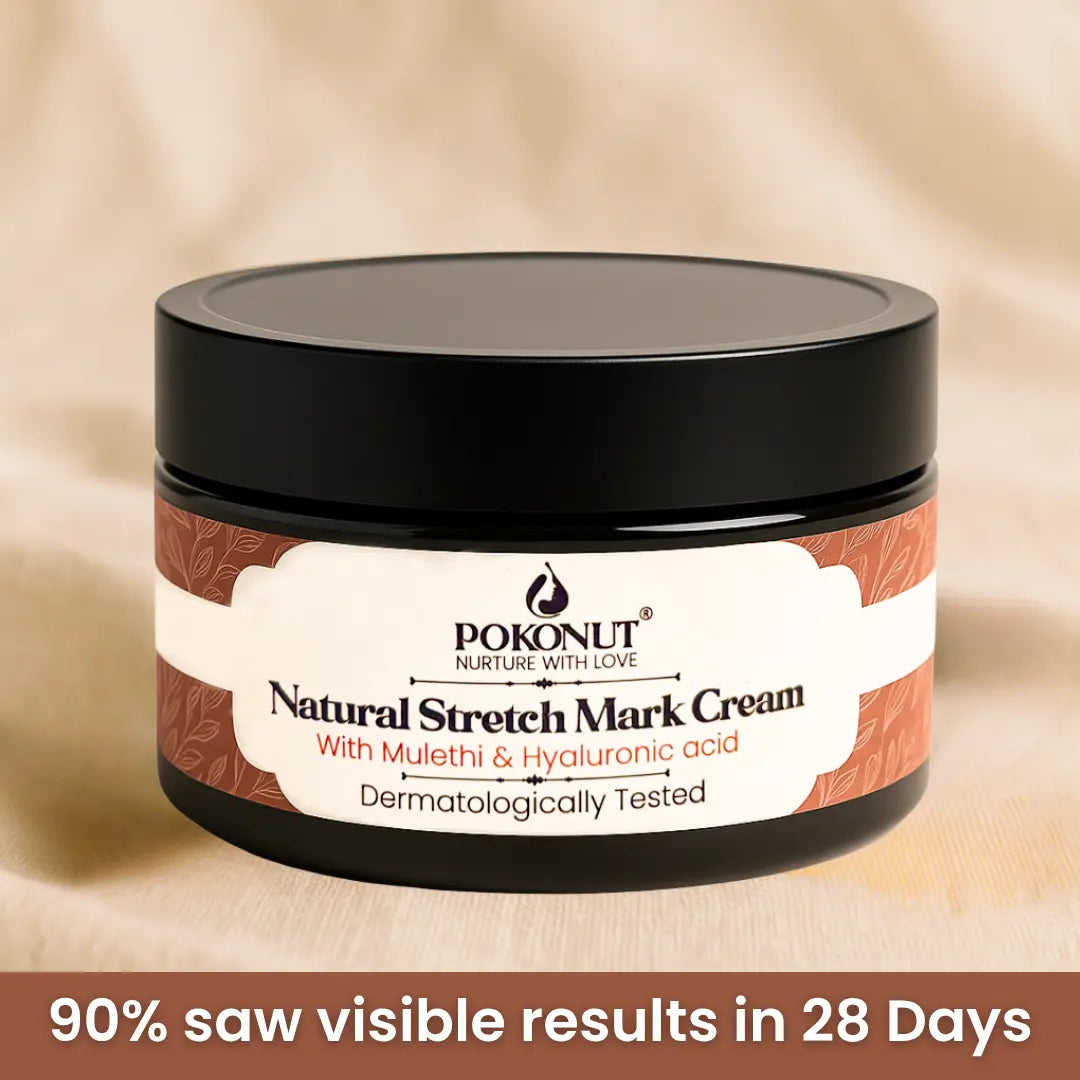
Pokonut Stretch Mark Cream
Stretch marks show up when skin stretches faster than it can rebuild during pregnancy, a growth spurt, a weight...
Shop Now →Coconut Oil or a Stretch Mark Cream: Which Works Better?
Coconut oil hydrates, while a formulated cream hydrates and adds ingredients that support skin elasticity and tone. For targeted care, a cream usually offers more.
Neither option removes stretch marks. The difference is what else is in the bottle.
|
Plain coconut oil |
Formulated stretch mark cream |
|
|
Main action |
Hydration and barrier support |
Hydration plus elasticity-supporting actives |
|
Typical ingredients |
Lauric acid, capric acid |
|
|
Pore-clogging risk |
Higher, as it is comedogenic |
Usually formulated to be non-comedogenic |
|
Texture |
Greasy, slow to absorb, can stain fabric |
Lighter and faster absorbing |
|
Cost |
Very low |
Higher |
|
Best use |
Simple daily moisturising and prevention |
Targeted care for newer and older marks |
Coconut oil is a sensible, affordable option if you simply want to keep skin soft. If you want more than hydration, a natural stretch mark cream that combines rosehip and centella with hyaluronic acid gives skin more support during and after stretching.
How Long Does It Take to See a Difference?
Expect softer, better-hydrated skin within a few weeks, and a subtle improvement in how marks look after roughly 4 to 8 weeks of daily use.
The timing depends heavily on the age of your marks. New red or purple marks are still changing and respond best to consistent care. Old white or silver marks are mature scars and change very little with any topical product. If older marks bother you, a dermatologist can discuss stretch mark treatment options such as microneedling or laser therapy, which have far stronger evidence for improving mature stretch marks.
The Bottom Line
Coconut oil will not remove stretch marks, and any product claiming otherwise is overpromising. What it does well is keep skin hydrated, soft, and less itchy while it stretches, and well-hydrated skin makes marks appear less obvious. It is inexpensive, safe in pregnancy, and easy to use, with one clear limitation: it can clog pores, so keep it to body skin rather than the face. Used early and consistently as part of a simple routine, it is a reasonable habit. Just judge it as a good moisturiser, not a cure.
About Doctor :