










Effective Home Remedies for Stretch Marks: A Comprehensive Guide

Medically Reviewed By:
Dr. Neeraj Bansal, BAMS
Written by Our Editorial Team
Dr. Neeraj Bansal, BAMS
Written by Our Editorial Team
Medically Reviewed By:About the Reviewer
Stretch marks are one of the most common skin concerns in the world, and one of the most misunderstood. Between 50% and 90% of women develop them during pregnancy alone, and they also appear during puberty, rapid weight change, and muscle gain from heavy training.
Here is the honest position before we go any further: no home remedy erases stretch marks completely, and any page that tells you otherwise is selling you something. What home remedies can do is keep stretched skin comfortable, support the skin's own repair process, and help newer marks look softer and less noticeable. Timing matters enormously — fresh red and purple marks respond far better than mature silver ones. This guide covers 15 remedies, what the evidence actually says about each, and precisely how to use them.
What are Stretch Marks?
Stretch marks, known medically as striae distensae, are a form of scarring that appears when skin is stretched faster than it can rebuild. They show up as narrow bands or lines, most often on the abdomen, thighs, hips, breasts, upper arms, and lower back.
The mechanism sits in the dermis, the skin's middle layer. When the body changes shape quickly, collagen and elastin fibres in the dermis tear. Elevated cortisol during pregnancy, puberty, or steroid use weakens those fibres further, making them more likely to give way. The lines you see on the surface are the deeper layers showing through where that structural network has broken. If you want the full mechanism, we cover it in detail in the science of stretch marks.
They are entirely harmless. They are not a sign of poor health, poor skincare, or anything you did wrong.

The Two Types of Stretch Marks
This distinction matters more than any remedy on this page, because it determines what is realistically achievable.
| Striae rubrae (New Marks) | Striae albae (Old Marks) | |
|---|---|---|
| Appearance | Red, pink, or purple; slightly raised | White or silver; flat, often slightly sunken and wrinkled |
| Age | New — weeks to months old | Mature — usually 6–12 months or older |
| What's happening | Active inflammation; blood vessels still visible; skin still remodelling | Inflammation resolved; scar tissue settled; pigment cells depleted |
| Response to treatment | Good. This is the window where topical care makes a visible difference | Limited. Topicals soften texture and tone but rarely remove the mark |
The practical takeaway: start early. Once a mark has turned white, you are managing its appearance rather than reversing it. A third variant, striae gravidarum, is simply the term for stretch marks that develop during pregnancy.
What Causes Stretch Marks?
- Pregnancy — the most common cause, typically appearing in the second and third trimesters as the abdomen expands.
- Puberty — growth spurts stretch skin on the thighs, hips, chest, and back faster than it can adapt.
- Rapid weight gain or loss — either direction can outpace the skin's ability to remodel.
- Muscle gain — rapid hypertrophy from heavy training commonly marks the shoulders, chest, and upper arms.
- Corticosteroid use — prolonged use of topical or oral steroids reduces collagen and weakens dermal structure.
- Genetics — if your mother or sister has stretch marks, your likelihood is significantly higher.
- Medical conditions — Cushing's syndrome (excess cortisol), Marfan syndrome, and Ehlers-Danlos syndrome all affect skin elasticity and can produce stretch marks without any obvious weight change.
15 Home Remedies For Stretch Marks
Each remedy below carries an honest evidence label. Research-supported means published studies point in a favourable direction. Limited evidence means the rationale is plausible but the trials are small, absent, or inconclusive. Traditional use means it has a long history in Ayurveda or folk practice without modern clinical backing.
1. Centella asiatica (gotu kola)
Evidence: research-supported. Of everything on this list, centella has the strongest case. This herb — mandukaparni in Ayurveda, and the "cica" of Korean skincare — appears to stimulate fibroblasts, the cells that produce collagen, and to blunt the glucocorticoid activity that degrades it. A 2015 review found creams containing centella may help prevent stretch marks in pregnancy and improve the appearance of existing ones.
How to use: apply a centella cream or gel to the affected area once or twice daily, massaging for two to three minutes. Continue for at least eight weeks before judging results.
2. Hyaluronic acid
Evidence: research-supported. Hyaluronic acid holds many times its weight in water, and research suggests it may protect fibroblasts from the mechanical stress that produces stretch marks in the first place. A 2017 review found it improved the appearance of striae, though the authors called for larger trials.
How to use: apply to slightly damp skin — hyaluronic acid draws moisture, and on bone-dry skin in low humidity it can pull moisture outward rather than in. Follow with an occlusive layer to seal it. Twice daily.
3. Aloe vera
Evidence: limited. Aloe has a genuine track record in wound healing and skin repair, and since stretch marks are a form of scarring, the rationale is reasonable. A 2018 trial tested aloe vera gel against sweet almond oil on pregnancy stretch marks with modest results.5 It will not remove marks, but it soothes and hydrates well and carries almost no risk.
How to use: slice open a fresh leaf, scoop the inner gel, and massage it into the marks. Leave for 20–30 minutes, then rinse. Daily, ideally after a shower.
4. Sugar scrub
Evidence: limited, but mechanistically sound. Microdermabrasion is one of the few clinically supported treatments for stretch marks, and a sugar scrub is a gentle domestic version of the same idea — controlled exfoliation that clears dead cells and prompts turnover.
How to use: mix ½ cup sugar with 2–4 tablespoons of almond or coconut oil until it holds together like wet sand. Rub over the area in circles for 5 minutes in the shower, then rinse with warm water. Two to three times a week — not daily. Make small batches and discard any that smell off.
5. Rosehip oil
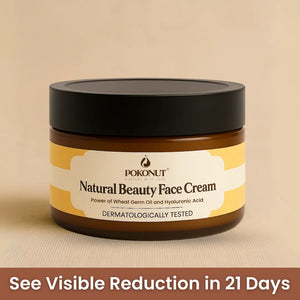
Evidence: research-supported. Rosehip is naturally rich in trans-retinoic acid precursors and vitamin C, and has been shown to reduce the severity of fresh stretch marks. It is one of the few plant oils with a mechanism beyond simple moisturisation, where Pokonut offers cream which comes natural remedies for stretch marks.
How to use: 4–5 drops massaged into clean skin at night. Keep it refrigerated — it oxidises quickly.
6. Topical vitamin A (retinol)
Evidence: research-supported — with an important caution. Retinoids are among the best-studied topicals for stretch marks. A 1996 study of tretinoin, the prescription-strength form, found marks appeared smaller and less severe with use.
Do not use retinoids if you are pregnant, breastfeeding, or trying to conceive. They carry known risks in pregnancy. Retinoids also cause irritation and sun sensitivity, so introduce them slowly and use sunscreen. This is one to save for after delivery.
7. Turmeric
Evidence: traditional use. Turmeric has been used across Indian households for generations for scarring and uneven tone, and curcumin has genuine anti-inflammatory activity — though direct trials on striae are lacking.
How to use: mix ½ teaspoon turmeric powder into a tablespoon of coconut or sesame oil to form a loose paste. Apply, leave for 15–20 minutes, then rinse. Once daily. Patch-test first; turmeric can stain lighter skin temporarily.
8. Argan oil
Evidence: limited. Argan is unusually high in vitamin E and linoleic acid, and small studies on skin elasticity have shown improvement with regular use. It absorbs faster than most carrier oils, which makes it practical for daily use.
How to use: a few drops massaged in for two to three minutes, morning and night.
9. Coconut oil
Evidence: limited. Coconut oil is a genuinely good barrier moisturiser and supports skin comfort on stretched, itchy skin — but studies have not shown it fades established stretch marks. Its real value may be the massage: the physical act of daily massage appears to matter as much as what you massage with.
How to use: warm virgin coconut oil between the palms and massage in circles for 5–10 minutes, twice daily.
10. Castor oil
Evidence: traditional use. Thick, deeply occlusive, and long used for scarring. Nothing published supports it for striae specifically, but it holds moisture on the skin exceptionally well.
How to use: massage a thick layer in for 10 minutes, then wrap the area in a warm cloth for 20 minutes to aid penetration. Two to three times a week.
11. Sesame oil massage (abhyanga)
Evidence: traditional use. Ayurveda's daily self-massage ritual, and the most authentically Ayurvedic entry on this list. Warm sesame oil massaged into the skin improves circulation and keeps stretched skin supple. Even setting tradition aside, the massage component has research behind it.
How to use: warm the oil slightly, massage into the whole area with long strokes and circular motions for 10–15 minutes, leave 20 minutes, then bathe.
12. Potato juice
Evidence: traditional use. Potato contains starch, vitamin C, and catecholase, an enzyme associated with reducing pigmentation. Widely used across India for marks and dark circles; no clinical trials support it for striae.
How to use: slice a raw potato, rub the cut face over the marks for 5 minutes, let the juice dry, then rinse with warm water. Daily.
13. Egg white
Evidence: traditional use. Rich in protein and amino acids, and it produces a temporary tightening effect as it dries.
How to use: whisk two egg whites to a light foam. Brush a thick layer over the marks, let it dry fully, then rinse and moisturise immediately. Two to three times a week.
14. Black tea
Evidence: traditional use. Popular in Indian home remedies for pigmentation, on the strength of tea's vitamin and antioxidant content.
How to use: boil two tablespoons of black tea leaves in a cup of water with a pinch of salt. Cool completely, then apply to the marks with cotton. Daily.
15. Lemon juice
Evidence: traditional use — use with care. The natural acidity acts as a mild exfoliant and lemon's vitamin C supports collagen production.
Important: lemon juice on skin causes photosensitivity and can trigger a burn reaction in sunlight. Apply at night only, rinse thoroughly after 10 minutes, and never go into sun on treated skin. Skip it entirely if your skin is sensitive.

What The Research Does Not Support
Being straight about this is more useful than another remedy.
The American Academy of Dermatology reports that in studies, popular home remedies did not work — researchers found that stretch marks did not fade when people massaged almond oil, cocoa butter, olive oil, or vitamin E into them. Cleveland Clinic reaches the same conclusion, adding coconut oil to that list while noting that aloe vera, hyaluronic acid, and centella asiatica do have research support. A Cochrane review of topical preparations for preventing stretch marks in pregnancy found the evidence too weak to recommend any single product.
Two more things worth knowing:
- Tanning does not help. Stretch marks do not tan, so a tan makes them more visible by increasing the contrast. A self-tanner, applied carefully, can camouflage them.6
- No cream removes stretch marks entirely. A good formulation keeps stretched skin hydrated and comfortable and can make newer marks appear softer. That is a real benefit. It is not erasure, and any product claiming otherwise is overstating its case.
None of this means the oils above are useless — they are excellent moisturisers, and comfortable, well-hydrated skin is worth having during pregnancy or rapid weight change. It means you should expect moisturisation, not removal.
Home remedies for pregnancy stretch marks
Pregnancy is when most stretch marks appear, and when the rules change.
Safe to use: aloe vera, coconut oil, sesame and almond oil massage, shea and cocoa butter, hyaluronic acid, and centella (topically). Gentle daily massage of the abdomen, hips, breasts, and thighs is the single most useful habit — it relieves the tight, itchy feeling of stretching skin, and the massage itself may help.3
Avoid: topical retinoids and any high-dose oral vitamin A. Be cautious with strong essential oils and with lemon juice.
When to start: as soon as skin begins to feel dry or tight, usually in the second trimester. Consult your obstetrician before introducing any new product, particularly in the first trimester.

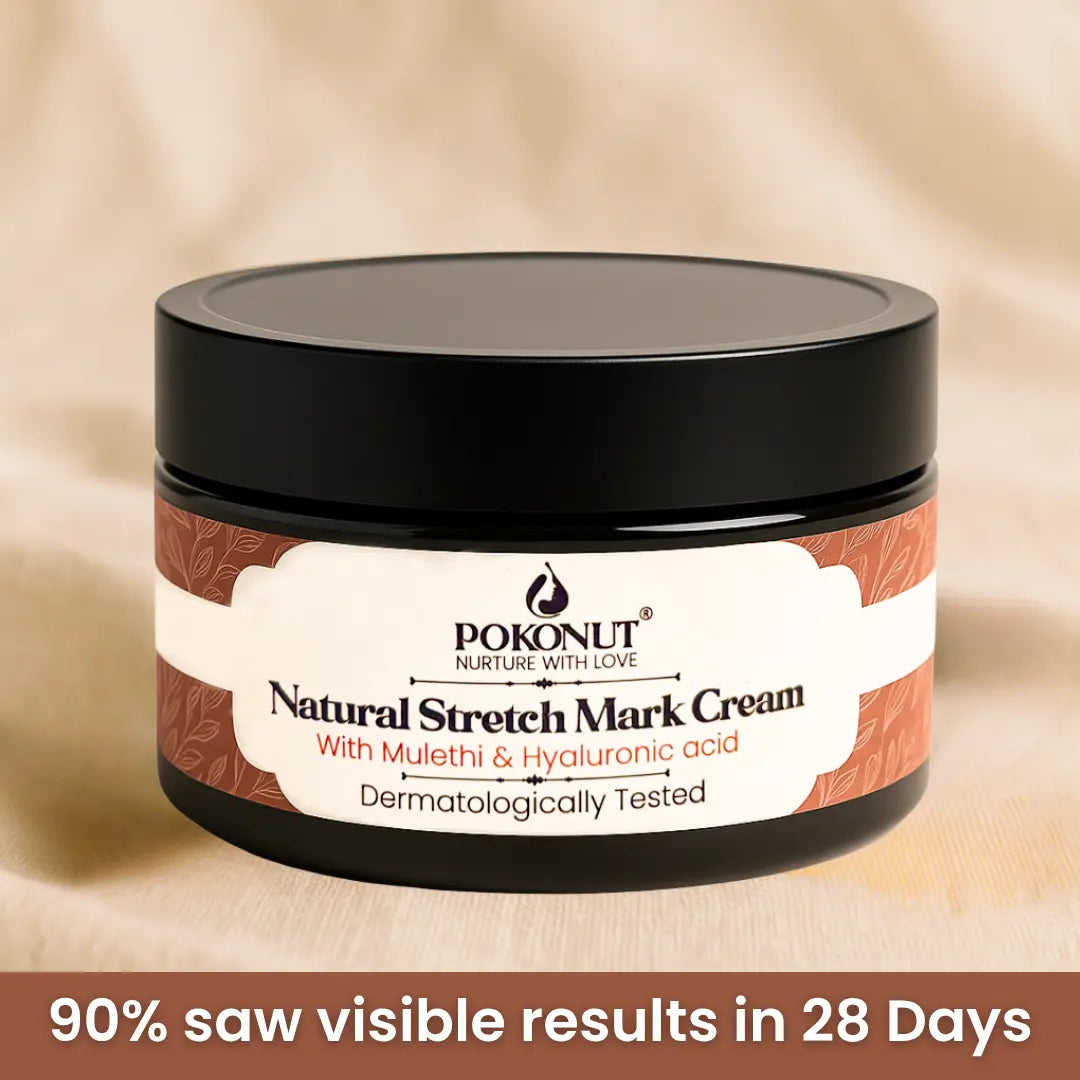
If you would rather not mix pastes and oils daily, Pokonut's stretch marks crem for pregnancy brings several of the ingredients above into one pregnancy-safe formulation — hyaluronic acid for hydration, rosehip seed oil for cell turnover, mulethi (licorice) to calm irritation and even out tone, alongside shea butter and coconut oil. It contains no retinoids and no parabens, is dermatologically tested, and is made in ISO- and GMP-certified facilities.
To be clear about what it does: it keeps stretched skin deeply moisturised, eases the dry and itchy feeling that comes with a growing belly, and with consistent use can make newer marks appear softer and less prominent. It will not erase mature white marks — nothing topical will. Patch-test before first use and check with your doctor during pregnancy. You can browse our full mom care range for pregnancy and postpartum skin.
When to See a Doctor
Stretch marks are cosmetic and almost never require medical attention. See a doctor if:
- Marks appear suddenly with no obvious cause — no pregnancy, weight change, or growth spurt
- They spread rapidly or cover an unusually wide area
- They appear alongside unexplained weight gain, easy bruising, fatigue, high blood pressure, or a rounded face — these can indicate Cushing's syndrome
- A child or young teenager develops extensive marks
- You are considering clinical treatment and want to know which option suits your skin type
About Doctor :
2 comments