












When Do Stretch Marks Appear in Pregnancy? A Month-by-Month Guide
- 1 In Which Month Do Stretch Marks Appear in Pregnancy?
- 2 Why Do Stretch Marks Form During Pregnancy?
- 3 Month-by-Month Guide to Pregnancy Stretch Marks
- 4 Where Do Stretch Marks Appear During Pregnancy?
- 5 Who Is More Likely to Get Stretch Marks?
- 6 Can You Prevent Stretch Marks in Pregnancy?
- 7 How to Care for Your Skin Each Month
- 8 When Do Pregnancy Stretch Marks Fade?
- 9 When to Talk to Your Doctor
- 10 The Bottom Line
Medically Reviewed By:
Dr. Mousumi Dash, BAMS
Written by Our Editorial Team
Dr. Mousumi Dash, BAMS
Written by Our Editorial Team
Medically Reviewed By:About the Reviewer
Most women notice stretch marks in the late second to third trimester of pregnancy, usually around months six and seven. Some see them as early as month five, and a few do not get them at all. They appear because the belly grows faster than the skin can adapt, while pregnancy hormones soften the skin's collagen and make it tear more easily. Stretch marks are very common, affecting an estimated 50 to 90 percent of pregnant women. They are harmless, and while they never fully disappear, they fade and become far less noticeable after birth.
Key Takeaways
-
Most stretch marks appear around months six and seven of pregnancy.
-
They can start as early as month five, or not appear at all.
-
They form from rapid skin stretching plus hormone-related changes in collagen.
-
They affect 50 to 90 percent of pregnant women, so they are normal.
-
Starting skin care early may reduce severity, but no cream is proven to prevent them.
In Which Month Do Stretch Marks Appear in Pregnancy?
Stretch marks most often appear between the sixth and seventh months of pregnancy, during the late second and third trimesters. This is when the belly expands quickly and the skin stretches faster than it can keep up with. That said, the exact timing differs from person to person. Some women notice the first marks as early as the fifth month, especially if they gain weight quickly or are carrying more than one baby, while others only see them in the final weeks before delivery. Timing depends mostly on skin elasticity, the pace of weight gain, and genetics. Marks usually begin once the belly, breasts, hips, and thighs start to grow noticeably.
Why Do Stretch Marks Form During Pregnancy?
Stretch marks form during pregnancy because of two things happening together: fast physical stretching of the skin and hormonal changes that weaken it. Here is what is going on beneath the surface.
-
The skin stretches faster than it can adapt. As the baby grows, the skin over the belly and other areas expands quickly. The middle layer of skin, called the dermis, tears when it cannot keep up with this pace.
-
Pregnancy hormones weaken the skin. Rising hormones such as cortisol reduce collagen and elastin, the fibres that keep skin firm and springy. With less of these fibres, the skin becomes more likely to tear.
-
Extra water loosens the skin's structure. These hormones also draw more water into the skin, which loosens the bonds between its fibres. Supporting the skin with hydrating ingredients like hyaluronic acid can help keep it more supple as it stretches.
-
The colour reflects the healing stage. When the skin tears, small blood vessels show through, so fresh marks look red, pink, or purple. After birth, these gradually fade to pale white or silver lines.
Month-by-Month Guide to Pregnancy Stretch Marks
Stretch marks are unlikely in early pregnancy and become most common from the sixth month onward as the belly grows. The table below shows what usually happens at each stage and what to focus on.
|
Stage |
What is happening to the skin |
Stretch mark likelihood |
What to focus on |
|
Months 1–3 (first trimester) |
The body is changing, but the belly has not grown much yet |
Low |
Start moisturising daily to build a habit and keep skin supple |
|
Months 4–5 (second trimester) |
The belly begins to expand and skin starts stretching |
Possible, early marks in some women |
Hydrate consistently, especially the belly, hips, and breasts |
|
Months 6–7 (late second to third trimester) |
Rapid belly growth stretches the skin the most |
Most common time for marks to appear |
Keep skin well moisturised and massage gently |
|
Months 8–9 (third trimester) |
The belly reaches its largest size |
Marks may increase or darken |
Continue daily care and stay hydrated |
|
After birth (postpartum) |
Skin slowly recovers and tightens |
Existing marks begin to fade |
Keep moisturising as red marks fade to white over months |
Where Do Stretch Marks Appear During Pregnancy?
Stretch marks appear most often on the belly, followed by the breasts, hips, thighs, buttocks, and lower back. These are the areas where the skin stretches the most and where the body stores fat during pregnancy. The belly is the most common spot because it expands the most as the baby grows. The breasts are also affected as they enlarge in preparation for feeding. How many areas develop marks, and how noticeable they are, varies from woman to woman and depends largely on skin type and how quickly the body changes.
Who Is More Likely to Get Stretch Marks?
You are more likely to get stretch marks during pregnancy if they run in your family, if you gain weight quickly, or if you are carrying more than one baby. The main factors are below.
-
Family history and genetics. This plays the biggest role. If your mother or sister had stretch marks in pregnancy, your own chances are noticeably higher.
-
Rapid or high weight gain. Gaining a lot of weight, or gaining it very quickly, stretches the skin faster. This makes marks more likely to form.
-
Carrying multiples. Twins or triplets stretch the belly more than a single baby. The extra stretching raises the chance of marks appearing.
-
Pre-pregnancy weight and age. A higher pre-pregnancy weight and your age can also influence how easily marks form, as skin elasticity varies from person to person.
-
What you can control. You cannot change your genes, but gaining weight gradually and keeping your skin well hydrated throughout pregnancy can help manage the risk.
Can You Prevent Stretch Marks in Pregnancy?
No cream or oil is scientifically proven to fully prevent stretch marks, but good skin care may reduce how severe they become. Here is what the evidence and practical experience suggest.
-
No product guarantees prevention. A large Cochrane review of clinical trials found no strong evidence that any topical product reliably prevents stretch marks. Treat bold prevention claims with caution.
-
Hydration still helps. Keeping skin soft and flexible makes it less itchy as it stretches. This can make marks less pronounced and far more comfortable.
-
Gradual weight gain matters. Gaining weight slowly and steadily gives the skin more time to adapt. Sudden jumps in weight stretch the skin faster and raise the risk.
-
Early and consistent care is worthwhile. Prevention cannot be guaranteed, but starting a gentle routine early is low-risk and supports healthier, more comfortable skin.

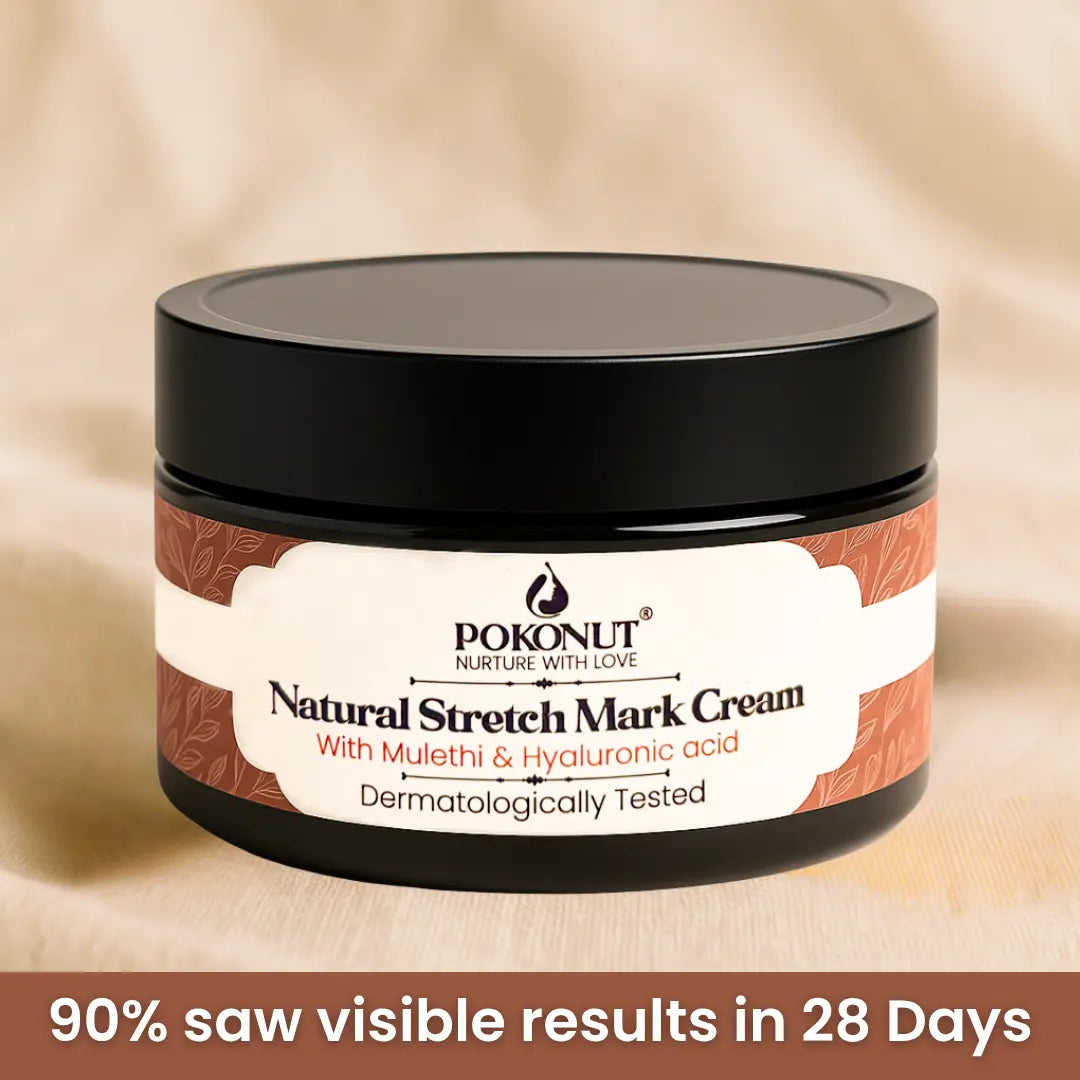
Pokonut Stretch Mark Cream
Stretch marks show up when skin stretches faster than it can rebuild during pregnancy, a growth spurt, a weight...
Shop Now →How to Care for Your Skin Each Month
The most effective approach is simple, gentle care started early and kept up consistently through pregnancy and after birth. A practical routine includes:
-
Start early. Begin moisturising in the first trimester, before the belly grows, to keep skin supple.
-
Moisturise daily. Apply to slightly damp skin after a bath to lock in moisture.
-
Focus on high-stretch areas. Pay attention to the belly, hips, thighs, and breasts.
-
Choose pregnancy-safe products. Use a stretch mark cream with hydrating, elasticity-supporting ingredients like hyaluronic acid, rosehip, and mulethi, and avoid retinoid-based creams, which are not recommended during pregnancy.
-
Massage gently. Circular massage improves circulation and encourages regular use.
-
Stay hydrated. Drinking enough water supports overall skin health.
-
Continue after birth. Keep moisturising as marks fade, since recovery takes months.
When Do Pregnancy Stretch Marks Fade?
Pregnancy stretch marks usually begin to fade within six to twelve months after delivery. In the weeks after birth, the red, pink, or purple colour slowly softens as the skin heals, and the marks turn pale white or silver. They also flatten and become far less noticeable over time. However, because stretch marks are a type of scar, they do not disappear completely. Consistent moisturising as part of your postpartum skin care can support the skin during this period, and for older marks that remain bothersome, a dermatologist can suggest treatments that work deeper than creams.
When to Talk to Your Doctor
You should speak to your doctor if stretch marks appear very suddenly and widely early in pregnancy, or if they come with other unusual symptoms. In almost all cases, stretch marks are a normal and harmless part of pregnancy and need no medical attention. But rapid, extensive marks alongside symptoms such as severe swelling, easy bruising, or unusual weight changes should be checked, as they can occasionally point to another condition. Your doctor can also advise which skincare products are safe to use during pregnancy if you are unsure.
The Bottom Line
Most pregnancy stretch marks appear around months six and seven, though the timing varies with skin type, weight gain, and genetics. They are extremely common, completely harmless, and a natural result of the skin stretching to make room for your baby. No product can guarantee prevention, but starting a simple, pregnancy-safe moisturising routine early, gaining weight gradually, and staying hydrated can keep skin comfortable and may reduce how noticeable marks become. After birth, they fade steadily with time.
About Doctor :